I have recently join the fine folks over at the Perfect Picture School of Photography! I'll be teaching a 4 week course centered around my popular Small Strobes, Big Results workshops. I'm very honored to joining such great instructors such as, Chris Hurtt, Bobbi Lane, Charlie Borland, Bryan Peterson and so many others.
If your looking for truly outstanding online courses, there is just one place to look, PPSOP! My first 4 week course starts October 9th, I hope you take the time to join my class.
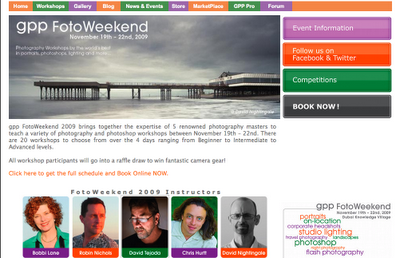
I'll be teaching in Dubai at GPP November 19th - 22nd, 2009. I am delighted and thrilled to be teaching along side such wonderful professionals like Chris Hurtt, Bobbi Lane, Robin Nichols and David Nightingale.
I'll be teaching a 2 day workshop focusing on corporate and industrial photography as well as two one day "Small Strobes, Big Results" workshop. It will be my first time to the UAE and I am very much looking forward to it.
These are going to wonderful workshops and if your in the area, I'd love to see at the workshops.
While on assignment in the San Luis Valley as noted on the previous post, I also shot several agricultural subjects for my client. I received a comp of this years annual report from the design firm prior to starting this assignment. Through phone conversations as well as having the comp in hand, I knew that the theme for this years annual was based around the phrase "We Deliver".
After Erik and I scouted the solar plant for locations to shoot the portraits shown on the previous post we when shooting farming activity until sundown. When shooting for an annual report, it is very important to keep focused on the message that the designer and client are addressing in the message of the annual report.
When shooting a framing activity like a combine in a wheat field, I would normally try to avoid "ugly" power lines in the photo. However, those "ugly" power lines are my clients lines and they mean money to them. It is my job as a photographer and yours, to keep your clients interests in mind while at the same time, create beautiful photography that both you and your client would be proud to display.
As the sun started it's journey further to the west we found this lone combine working in a field of wheat. The combine was not under my control for these images, this was simply a chance happening that we found this activity taking place.
We drove up to the side of the field looking for angles that would allow us the opportunity to put power lines and a small sub station at the south end of the field in the photo. All the images contained in this post are the same location, same combine. My first choice of course, would have been to have complete control over the movement of the combine. Prior arrangements and a walkie talkie would have been nice. We had to wait for the normal movement of the combine, working it's way to the north then west and again back south. The cycle took about 8 or 10 minutes for each opportunity to photograph the combine. I had a total of about 3 passes to create the images you see here.
Ain't those power lines purdy? How about these below!
I was concentrating mostly on the southern view, as it allowed me to include more power lines for the client. After 2 relatively close passes, the combine operator stopped his combine to talk with us. He was curious about what we were doing, we introduced ourselves and I told him I was photographing for the coop. As I stood there talking with him the light was edging ever closer to the horizon. I noticed that the sky and light looking north was quickly becoming beautiful and I asked if he would mind jumping back in his combine and continue driving north.
Clouds in the valley started becoming more prominent in the north and I was able to capture the following image as he drove off.
I happened to be wearing shorts this day and I found myself running waist high in the wheat in order to position myself for several of the shots. I keep asking Erik if there was such a thing as a "wheat snake" and weather or not I needed to hurry about any other type critters I the field. This turned out to be a mistake, Erik took this opportunity to scare the crap out of me with all sorts of descriptive creatures I needed to look out for.
We also managed to shoot a little video on this portion of the shoot in the San Luis Valley. I really like shooting agriculture subject matter, I hope to shoot more before the season is out.
I have recently begun working on an annual report for a long time client on mine. My client is a Touchstone Cooperative who owns power plants and transmission lines. I have shot their annual report for years and it is now time to start this years annual.
Quite often when I head out on assignment for them, we have several other project to shoot other than the annual report photography. These portraits may or may not appear in their annual report, they may end up in their monthly magazine.
Erik and I had two days of shooting in the San Luis Valley in southern Colorado. We were shooting a variety of subject matter, combines harvesting fields, portraits around solar panels and a potato farmer Scott.
This particular post will be devoted to the solar panel portrait portion of the assignment. Before heading down to the San Luis Valley, I was told that we were scheduled to shoot portraits at a solar plant near Alamosa, Colorado the following morning.
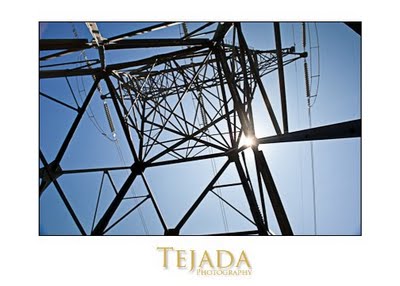
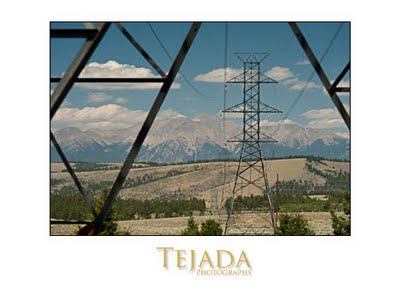
Erik and I left for Alamosa early in the morning, allowing us plenty of time to shoot alone the way. I was asked to photograph some new power lines which had been recently installed over Poncha Spring Pass alone Colorado Hwy 285. We took our time going over the pass, turning on various forestry roads looking for good vantage points to photography those power lines. By the time we had reached this location it was near mid day, and the light was a bit harsh.
After photographing various angles on power lines we continued our trip to the Alamosa. Just 17 miles north of Alamosa is a small solar plant which Sun Edison operates and my client providing the power lines to deliver the resulting power. We drove around the solar plant scouting for locations for the portraits we knew we were going to be shooting the following morning.
I was told that there was a small sub station on the north/west corner of the property, and my client wanted the substation in the background of the photos we're going to shoot. Based on the placement of the sub station, I needed to be inside the solar plant property to get the photography my client asked for.
I made a few personal photos of the plant while scouting the location for the morning shoot. On the morning of the photo shoot at the solar plant, I learned that my client was unable to make contact with the appropriate person to gain access to the plant. I had about 30 minutes to come up with a solution, photographing a group of 6 or 7 people in a location that says solar power and delivery. We drove out to the plant prior to the arrive of the individuals who were to be photographed, looking for a solution. When we arrived, I noticed a repair or maintenance crew on the property. I caught their attention and spoke to them about the situation at hand. I told them that we had be trying to get permission from a certain gentlemen with Sun Edison and that we had not yet heard back from him regarding gaining access to their property. As it turned out, these workers made a quick phone call which quickly allowed us the access we desired.
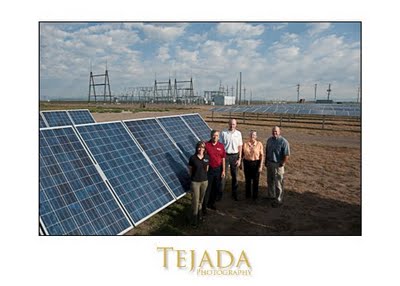
Once on the property, I was able to position the group of 6 near solar panels with the sub station in the background. With the aid of a 6 foot ladder, I was able to get a higher angle to see more of the sub station as well as seeing more solar panels.
After shooting the group, I was asked to make several individual portraits as well as smaller group shots. The photo at the top of the post was photographed utilizing a 42" square lightform panel with a diffusion fabric over the frame. Erik moved the panel into the frame from the left side until I could just see it, and than backed it out just out of frame. Using a panel like this produces a soft light on the subject. Here are a few more images from our morning shoot at the solar plant.
In this image you can see the sub station in the background on the left side of the frame. If I had to shoot this without being on the solar plant property, I don't know what I would have done.
We also shot a little video to go alone with this assignment.
It may be hard to see in the small photo above, in this 30 second exposure I managed to capture the Space Shuttle passing over head. Click on the above image and see if you can see the light streak in the center of the frame. Here is a link to the scheduled viewing of both the Space Shuttle and the International Space Station.
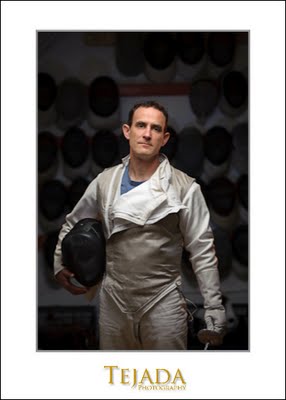
In part 1 of my fencing shoot, we combines a small amount of ambient light with a single flash with a grid. With this photo, I killed the ambient light choosing instead to light the entire scene with strobes. I used a much softer quality light on my subject, opting for a overhead softbox. I positioned my subject in front of a wall rack full of fencing masks, the repetitive pattern of the masks made for a nice background.
For this series of photos I untimely ended up using 4 Nikon SB-800 strobes. The strobes all fired using the Nikon CLS system. My key light is a single SB inside a FourSquare™ the strobe was set to group A and boomed overhead. A used a Quantum Turbo SC battery to power the strobe.
For the rim or kicker lights, I had two SB-800's, each with a full cut CTO (color temperature orange) gel on the flash head. I used a set of barndoors on each strobe to control the spread of light and help prevent flare in my lens. I assigned both strobes to group B as they had the same distance to travel and both strobes received the same amount of power. Just as a side note: All strobes assigned to a particular group in this case group B, will all fire at the same power level. You can not adjust each strobe independently if they are assigned to the same group.
The background flash was an SB-800 with a full cut CTB (color temperature blue) gel on it. A CTB gel converts a tungsten light source to daylight. Since the strobe is already a "daylight" balanced light source, the gel raises the kelvin temperature which has a cooling affect on the light. The flash head was zoomed to 50mm and place into group C.
From my camera position and using the SU-800 commander, I was able to shut off the various groups to show the build of lights. In the following series of photos you can see the progression of adding lights on the subject. The first with just the key light, the second with the addition of kickers, and the third with all strobes firing including the background.
Here I'm fitting one of the rear kicker strobes with a barndoor. These are really inexpensive modifiers and I use them a lot. They cost about $10.00 each.
You may have notice that I make no mention about what power settings I'm using. Personally I don't care, I make a creative choice to shoot at certain aperture and than adjust the power on the strobes to fit that. I wanted a shallow DOF to soften the background, that happened to be f/2.8.My son Chris shot some video during the shoot, it shows the photographing of both part 1 and part 2 of these posts.

 I have recently join the fine folks over at the Perfect Picture School of Photography! I'll be teaching a 4 week course centered around my popular Small Strobes, Big Results workshops. I'm very honored to joining such great instructors such as, Chris Hurtt, Bobbi Lane, Charlie Borland, Bryan Peterson and so many others.